Gold Just Got ₹1,391 Per Gram More Expensive Overnight — Here's Exactly Why and What Happens Next
By Satyapal Khakhal, Founder & Financial Content Author, gpaisa.in
Wednesday, May 13, 2026 | Breaking News | Sources: Finance Ministry, BusinessToday, The Week, IBJA
If you checked gold prices this morning and did a double-take, you were not imagining it.
24K gold has crossed ₹16,789 per gram today — up from ₹15,398 yesterday. That is a jump of ₹1,391 per gram, or roughly ₹13,910 more per 10 grams in a single day. For a family buying 100 grams of gold jewellery for a wedding, that is ₹1,39,100 more than it would have cost just 24 hours ago.
This did not happen because of some mysterious market force or global panic. It happened because of a very specific government decision made yesterday morning — and once you understand it in plain terms, the price you are seeing today will make complete sense.
The One Thing That Changed: Import Duty Nearly Tripled Overnight
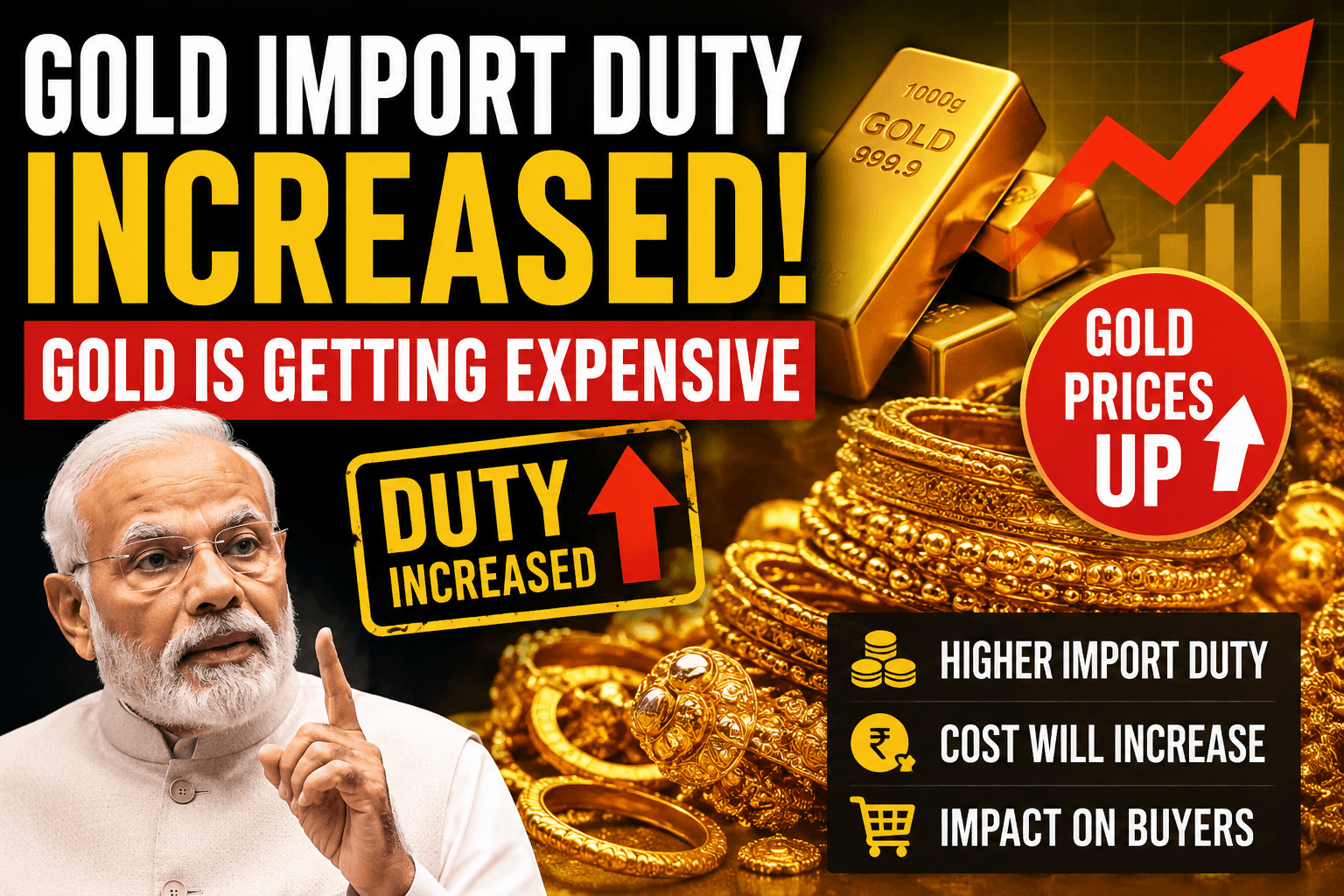
On Wednesday, May 13, 2026, the Finance Ministry of India issued an order raising the import duty on gold and silver from 6% to 15% — effective immediately.
That is not a small adjustment. That is the government taking a tax that was 6 paise on every rupee of gold imported and turning it into 15 paise. For a metal that costs over ₹15,000 per gram, that difference lands directly on the price you pay at the jeweller's counter.
Here is the simple breakdown of what this 15% now consists of:
| Component | Rate | What It Is |
|---|---|---|
| Basic Customs Duty | 10% | Standard import tax collected by customs at the port |
| Agriculture Infrastructure & Development Cess (AIDC) | 5% | An additional levy that goes toward agriculture development funds |
| Total Import Duty | 15% | Up from 6% before today |
Add 3% GST on top of this (which was already applicable), and the effective tax burden on imported gold in India is now among the highest in the world.
Why Did the Government Do This? The Real Reason in Plain Language
India has a problem right now that most people are not fully aware of — and the gold duty hike is a direct response to it.
Think of India's foreign exchange reserves as the country's emergency savings account. Ten weeks ago, that account held $728 billion. Today it holds $690 billion. India has spent roughly $38.5 billion of its forex reserves in just 10 weeks — and it is happening primarily because of two things.
First, the ongoing US-Iran war has effectively closed the Strait of Hormuz — the narrow waterway through which nearly half of India's crude oil and over 80% of its LPG arrives. With that route disrupted, oil has to come from farther away, at higher prices. Brent crude has risen from around $73 per barrel before the war to over $107 today — and it touched a four-year high of $126 in late April. Every extra dollar on an oil barrel multiplies into billions of dollars of extra spending for a country that imports as much oil as India does.
Second, India imports almost all of its gold from abroad — roughly 700–900 tonnes every year, costing $35–55 billion in foreign currency annually. In a normal year, that is a large but manageable expense. Right now, with the forex reserve depleting fast because of the oil crisis, every dollar spent on gold imports is a dollar that could have helped stabilise the rupee or fund essential imports.
India's current account deficit — the gap between what the country earns from the world and what it spends — is now projected to widen to 1.3% of GDP, up from 0.8% just months ago. The government needed to act.
PM Modi asked nicely on Sunday. By Wednesday, it became policy.
Today's Gold and Silver Prices — May 13, 2026
| Metal / Purity | Today's Price (per gram) | Per 10 Grams | Change vs Yesterday |
|---|---|---|---|
| Gold 24K (999) | ₹16,789 | ₹1,67,890 | ↑ ₹1,391/gram (+9.0%) |
| Gold 22K (916) | ₹15,390 | ₹1,53,900 | ↑ ₹1,275/gram (+9.0%) |
| Gold 18K (750) | ₹12,592 | ₹1,25,920 | ↑ ₹1,043/gram (+9.0%) |
| Silver 999 | ₹290.10 | ₹2,90,100/kg | ↑ sharply |
Source: Goodreturns, IBJA, MCX. Rates as of Wednesday morning session, May 13, 2026. Excludes making charges and GST on jewellery. Check our live gold rate page for intraday updates.
To put today's price in perspective: on January 1, 2024, 24K gold cost approximately ₹6,300 per gram. Today it costs ₹16,789. That is a 166% increase in 17 months — two-and-a-half times your money if you had bought then.
Has India Done This Before? Yes — And Here Is What Happened Last Time
This is not the first time India has used import duty as a weapon against gold demand. The history is important because it tells us what is likely to happen next.
In 2013, when India faced a severe current account deficit crisis — very similar to today's situation — the government raised gold import duty from 4% to 10% in three steps within months. What happened? Official gold imports fell sharply in the short term. But simultaneously, smuggling surged. Gold started coming in through unofficial channels — in diplomatic baggage, in aircraft lavatories, through border routes — because the profit margin for smugglers was enormous. The black market for gold expanded visibly during that period.
The government eventually brought duty back down. India raised gold import duty again during the Russia-Ukraine war in 2022, taking it to 15% — the same level it sits at today. Then, in the Union Budget 2024-25, duty was cut back to 6% specifically to revive the gems and jewellery industry and reduce smuggling. That cut worked: smuggling declined, official imports rose, the jewellery sector recovered.
Now that cut has been entirely reversed. Wednesday's hike takes us straight back to the 2022 level, but in a more volatile global environment.
Surendra Mehta, National Secretary at the India Bullion and Jewellers Association (IBJA), acknowledged the government's intent while flagging the risks: the duty hike will affect demand, and it could revive grey market activity that had quietened down after 2024's reduction. A Mumbai-based bullion dealer at a private bank was more blunt: "Grey markets are likely to become active. At current price levels, smugglers could make significant profits."
What Does This Mean for Gold Prices Going Forward?
Today's 9% jump has already priced in most of the duty hike's immediate impact. But there are several ways this story develops from here, and they do not all point in the same direction.
Prices stay elevated or rise further if: The West Asia conflict deepens, the rupee weakens further, or the US Fed signals rate cuts (which would weaken the dollar and boost international gold prices). The government's own Finance Ministry source told PTI that the duty hike is a "price-based disincentive" — meaning the government expects higher prices to reduce demand. Higher prices that reduce demand do not necessarily reverse; they may simply persist at elevated levels with lower buying volumes.
Prices could correct moderately if: A ceasefire or resolution in the US-Iran conflict eases global risk sentiment, the rupee strengthens, or domestic demand falls so sharply that jewellers and bullion dealers are forced to offer discounts. The duty hike itself cannot be reversed quickly — that would require another gazette notification and political will, which is unlikely in the short term.
The most likely scenario: Gold prices in India stay in the ₹16,000–₹17,500 range for the next 2–3 months, significantly elevated from pre-hike levels, with periodic corrections of 2–4% on positive global news. The structural floor is now higher because of the duty change — even if international gold prices soften, the domestic price is insulated upward by the new tariff wall.
What Should You Do Now? Practical Guidance by Buyer Type
If you have a wedding in the next 30–60 days: You are in the most difficult position of any buyer category today. The price you were mentally budgeting for — likely around ₹15,000–₹15,500 per gram — is already gone. The new reality is ₹16,789 per gram with no near-term prospect of a return to previous levels. For families with fixed budgets, this means either reducing the quantity of gold purchased, or increasing the budget. Waiting for prices to fall back to pre-hike levels is not a realistic strategy — that would require the government to reverse the duty, which is unlikely while the West Asia crisis continues. Buy what you need, budget at today's prices, and avoid taking loans specifically to buy gold at these elevated levels.
If you were planning a gold investment: The duty hike changes the calculus significantly. The 9% jump today means anyone who buys now is already entering at a post-spike level. For long-term investors with a 5+ year horizon, the fundamental case for gold — inflation hedge, rupee depreciation protection, global uncertainty premium — remains intact. But entering with a large lump sum at ₹16,789 per gram, after a 166% rally since 2024, carries meaningful short-term risk. A systematic monthly approach through gold ETFs or digital gold is more prudent than a large one-time purchase at today's peak.
If you hold existing gold: Today is a good day to review your portfolio. If you hold physical gold, SGBs, or gold ETFs that you purchased before 2024, your returns are now extraordinary — over 100% in most cases. Whether to hold or partially book profits depends on your overall financial plan. The duty hike's effect on demand could create a short-term ceiling on domestic prices even if international prices continue to rise.
If you were considering Sovereign Gold Bonds: SGBs remain the most tax-efficient way to gain gold exposure without contributing to imports. They are backed by the Government of India, earn 2.5% annual interest, and gains at maturity are completely tax-free. The duty hike does not affect SGBs — they are settled in cash at the prevailing gold price, not in physical metal. For investment purposes, if RBI announces a new tranche, it remains worth considering even at current price levels.
The Jewellery Industry's Concern: Will Smuggling Return?
This is the uncomfortable question that the government must be weighing even as it announces the hike. India's gems and jewellery industry is worth approximately ₹5 lakh crore and employs millions of artisans, goldsmiths, and retail workers across the country. The All India Gems and Jewellery Council (GJC) has already warned that the duty hike will hurt the industry and — perversely — encourage smuggling.
The math is simple. At 15% duty plus 3% GST, importing gold through official channels now costs roughly 18% more than the international price. For smugglers, that 18% gap represents pure profit on every gram brought in illegally. At ₹16,789 per gram, that profit margin is over ₹3,000 per gram — an extraordinary incentive for illegal imports.
This is not a hypothetical risk. India experienced exactly this pattern in 2013–14 when duty was at 10%, and the DRI (Directorate of Revenue Intelligence) reported a dramatic spike in gold seizures. The government eventually cut duty partly because smuggling was undermining the very goal of reducing imports. Whether history repeats itself will depend on how effectively customs enforcement is ramped up alongside the duty increase.
The Bigger Picture: Why This Matters Beyond Gold
The gold duty hike is not happening in isolation. It is one piece of a broader government response to a genuine economic stress situation created by the West Asia conflict. In the past two weeks, PM Modi has asked citizens to reduce fuel consumption, avoid foreign tourism, work from home, and avoid unnecessary imports. PwC has reportedly told employees to travel only for clear business needs. Uday Kotak warned of "tough times ahead."
These are not the actions of a government managing a routine economic situation. India is managing the economic shock of a regional war that has disrupted its energy supply chains, weakened its currency, and put pressure on foreign exchange reserves at an unusually rapid pace. The gold duty hike is the most consequential policy tool deployed so far — and it will not be the last economic adjustment Indians experience if the West Asia situation does not resolve in the coming weeks.
For gold buyers, the takeaway is simple: the price environment has structurally changed today. Budget at ₹16,000–₹17,000 per gram, plan your purchases accordingly, and do not wait for a return to May 11's prices. They are gone for now.
Frequently Asked Questions
Why did gold price suddenly increase so much today, May 13, 2026?
The Government of India raised the import duty on gold and silver from 6% to 15% effective May 13, 2026. Since India imports nearly all of its gold, this duty increase is directly passed on to buyers, causing prices to spike sharply. The move was made to reduce gold imports and ease pressure on India's foreign exchange reserves, which have been depleted by rising crude oil costs caused by the US-Iran war disrupting the Strait of Hormuz.
What is the new gold import duty in India in 2026?
The new gold and silver import duty is 15%, comprising a 10% basic customs duty and a 5% Agriculture Infrastructure and Development Cess (AIDC). This replaces the previous 6% rate. In addition, a 3% GST applies on all gold purchases, bringing the effective total tax burden on imported gold to approximately 18%.
Will gold prices come down after the import duty hike?
The duty hike creates a structural price floor — gold would need to fall significantly on international markets to return to pre-hike domestic levels. A reversal of the duty is unlikely in the near term while the West Asia crisis continues. Short-term corrections of 3–5% are possible, but a return to the ₹15,000–₹15,500 per gram range seen last week is not expected without both a global price fall and a duty reversal.
Should I still buy gold for my wedding after the price hike?
If you have a confirmed wedding date in the next 30–60 days, waiting for prices to fall back to pre-hike levels is not a reliable strategy. Budget at today's prices (approximately ₹16,789 per gram for 24K), reduce the quantity if needed, and make purchase decisions based on what you can comfortably afford rather than on price speculation. Avoid taking personal loans at high interest rates to fund gold purchases at these elevated prices.
Is gold investment still a good idea at ₹16,789 per gram?
For long-term investors (5+ year horizon), gold's fundamental drivers — inflation protection, rupee depreciation hedge, geopolitical safe-haven demand — remain in place. Entering with a large lump sum after a 166% rally since 2024 carries short-term risk. A systematic monthly investment through gold ETFs or digital gold is more prudent. Sovereign Gold Bonds, when available, remain the most tax-efficient option for investment-oriented buyers.
Related reading: PM Modi's Gold Appeal: Full Explainer | Gold vs Fixed Deposit in 2026 | Live Gold Rate Today
Disclaimer: This article is for informational and educational purposes only. All prices are sourced from Goodreturns, IBJA, and MCX as of May 13, 2026. Gold prices are highly volatile and may change significantly throughout the day. Policy information is sourced from Finance Ministry announcements, PTI, BusinessToday, and The Week. This is not financial advice. Please consult a SEBI-registered financial advisor before making investment decisions.